June 1, 2026
Common House Ant Species and How to Tell Them Apart
Ants in the kitchen all look about the same at first glance: small, dark, marching in a line. That impression is also the most common reason ant treatments fail. The “small dark ant” you are seeing could be one of five species commonly found in US homes, and the right answer for each one is different. Solid house ant identification is the first step that separates a treatment that works from a treatment that drives the colony underground for two weeks before it comes back. Here is how to tell the most common species apart, and why species ID changes the treatment plan.
The Five Species You Actually See Indoors
There are over 700 ant species in the United States, but a homeowner only encounters a handful inside the house. Knowing these five covers roughly 90% of indoor ant calls across our service area.
| Species | Size | Color | Key ID Marker |
|---|---|---|---|
| Odorous house ant | 2.4 to 3.3 mm (1/16 to 1/8 in) | Brown to black | Smells like rotten coconut when crushed |
| Pavement ant | 2.5 to 4 mm (3/32 to 1/8 in) | Dark brown to black | Two visible nodes on the waist, parallel lines on head and thorax |
| Carpenter ant | 6 to 13 mm (1/4 to 1/2 in) | Black, reddish, or two-toned | Largest, smooth rounded thorax in side profile |
| Pharaoh ant | 1.5 to 2 mm (1/16 in) | Yellow to light brown | Tiny, pale, often in heated indoor areas year-round |
| Fire ant (imported) | 2 to 6 mm (varies) | Reddish-brown | Aggressive, builds soil mounds, painful sting |
💡 Key Takeaway: Size and color get you to the right neighborhood. The waist shape, thorax profile, and crushed-ant smell get you to the species. Most homeowners can confirm an ID with a clear photo and a magnifying glass.
Odorous House Ant (Tapinoma sessile)
The most common indoor ant in the United States, and the one most often misidentified. Workers are uniform in size at roughly 3 mm, with a body that is dark brown to nearly black. From above, the waist appears to have no node at all because the petiole is hidden by the rear of the body. Utah State University Extension notes that odorous house ants are an emerging pest in Utah, where they often get confused with the dominant pavement ant.
The defining trait is the smell. Crush an odorous house ant between your fingers or under a paper towel and you get a sharp, sweetish odor that most people describe as rotten coconut or stale Pine-Sol. Pavement ants do not smell when crushed. If the smell is there, you have odorous house ants.
Why it matters for treatment: odorous house ants have multiple queens and split colonies through a process called budding. Spraying the visible trail with a contact insecticide can actually accelerate budding by stressing the colony into reproducing more aggressively. Bait-based treatment is the standard approach, and patience is part of the plan.
Pavement Ant (Tetramorium immigrans)
Pavement ants are similar in size and color to odorous house ants, which is why misidentification is so common. Workers run 2.5 to 4 mm and range from dark brown to black. The cleanest way to tell them apart from a small-ant lineup is the waist. Pavement ants have two distinct nodes between the thorax and the abdomen. Under a magnifying glass you can also see fine parallel lines running across the head and the top of the thorax, almost like wood grain.
Pavement ants get their name honestly. They nest in soil under sidewalks, driveways, foundation slabs, and patio stones, and you usually see the small piles of excavated dirt at the seams. Indoor activity is most common after heavy rain when the colony floods, or in late summer when colonies expand foraging range. Unlike odorous house ants, pavement ants do not smell when crushed.
Treatment leans on perimeter bait placement at exterior entry points and around foundation seams. Indoor sprays kill the foragers but do nothing to the colony, which is the same trap most retail products fall into.
Carpenter Ant (Camponotus species)
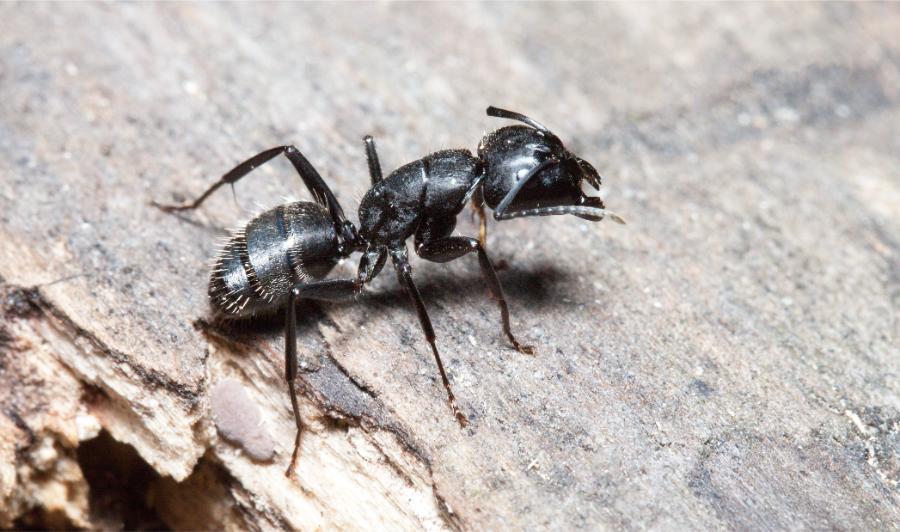
The big one. Carpenter ant workers can reach 13 mm (half an inch), and the size alone usually rules out the other species on this list. Most carpenter ants in the eastern US are uniformly black, but some species are reddish or two-toned with a black abdomen and a reddish thorax. The species name is the giveaway: carpenter ants do not eat wood, but they excavate it to build galleries, which is why a serious infestation can compromise structural framing.
The reliable ID trick is the side profile of the thorax. A carpenter ant’s thorax is a smooth, even curve from front to back. No bumps, no spines, no irregular shapes. Every other common house ant has a thorax with at least one visible bump or angle. If the side profile is a clean arc and the ant is half an inch long, you almost certainly have a carpenter ant.
Other carpenter ant signs:
- Frass: fine sawdust mixed with insect-part fragments, usually piled near a hidden gallery entry.
- Late-night activity: carpenter ants forage heavily at dusk and overnight, much more than during the day.
- Winged swarmers in spring: large, black, often mistaken for termite swarmers (more on that below).
- Moist or damaged wood nearby: carpenter ants nest in wood that has been softened by moisture, which is why finding the colony often means finding a leak.
Treatment matches the colony location, and finding the colony is half the job. A proper inspection for carpenter ants includes a moisture check, a trace of foraging trails back to the harborage, and treatment of both the visible trail and the gallery once located. This is firmly in the call-a-pro category. More on that in our ant control service overview.
💡 Key Takeaway: Carpenter ant swarmers and subterranean termite swarmers both fly in spring, both have wings, and both can appear in identical numbers near the same window. Termite swarmers have equal-length wings, no waist, and straight antennae. Carpenter ant swarmers have unequal wings (forewings noticeably longer), a clear pinched waist, and bent (elbowed) antennae. The treatment for these two species is entirely different. Get the ID right.
Pharaoh Ant (Monomorium pharaonis)
Tiny, yellow to light brown, and notable for being a year-round indoor pest. Pharaoh ants are 1.5 to 2 mm long, smaller than every other species on this list, and the pale color makes them easy to miss on light-colored surfaces. They thrive in heated indoor environments and are common in apartment buildings, hospitals, hotels, and any large structure with a lot of interior plumbing and warmth.
Pharaoh ants are the species most often associated with hospital infestations because they can mechanically transmit pathogens. They also have multiple queens and split colonies aggressively when stressed, which is the part that makes them difficult to treat. Spraying pharaoh ants with a contact insecticide causes the colony to bud into multiple smaller colonies, sometimes spreading the problem to other rooms or other units in a multi-family building. Bait-only treatment is the standard, and even then it can take weeks to months to fully resolve.
Fire Ant (Solenopsis invicta)
The imported fire ant is mostly an outdoor problem in the southeastern US, including across our Alabama service area. Workers are reddish-brown, vary in size from 2 to 6 mm even within the same colony, and are immediately recognizable by behavior: disturb a mound and the colony pours out aggressively, stinging anything that touches it. Mounds in lawns are often the size of a softball to a basketball, with no central entry hole visible on the surface.
Fire ants rarely come indoors as a primary pest, but they do enter homes after flooding or when foraging during very dry weather. Indoor treatment is rare. Outdoor treatment uses broadcast bait formulations across the yard rather than direct mound treatment, because individual mound treatment usually causes the colony to relocate rather than die. Family yards, kids’ play areas, and pet zones are the priority treatment areas in fire-ant country.
Quick ID Field Guide
The fastest way to narrow down a small dark ant in your kitchen:
- Size first. If the ant is half an inch or larger, it is a carpenter ant. If it is under 2 mm and pale yellow, it is a pharaoh ant.
- Crush test second. Small dark ant, 2 to 4 mm, crushed under a paper towel: if it smells like rotten coconut, odorous house ant. If no smell, pavement ant.
- Color check for fire ants. Reddish-brown ants outdoors in a soil mound, especially in Alabama or other southern states, are imported fire ants until proven otherwise.
- Photograph if uncertain. A clear close-up photo of the side profile, ideally with a ruler or coin for scale, is enough for most pest professionals to confirm species over text or email.
Why Species Matters More Than People Think
Retail ant sprays are mostly variations on the same active ingredients, and the labels are broad on purpose: kills ants, period. But the placement strategy differs by species, and the product class matters too.
- Contact spray on odorous house ants or pharaoh ants: makes the problem worse by triggering budding.
- Bait gel on carpenter ants: useful but insufficient on its own. The colony has to be located and treated directly.
- Generic perimeter spray on pavement ants: works for short-term knockdown but does nothing to the soil-based colony.
- Mound treatment on fire ants: causes relocation rather than elimination in most cases.
The pattern is the same one across pest control: the right treatment depends on the species, the lifecycle stage, and where the colony is located. That is the work that an inspection does before any product is applied. Get the ID right, then build the treatment to match.
💡 Key Takeaway: When in doubt, take a clear photo with something for scale and send it to your local pest control office before buying any product. Misidentification costs you a season of activity. Correct identification is free.
Have questions? Give us a call.
Frequently Asked Questions
Why does spraying ants seem to make them spread to new rooms?
Two of the most common indoor species, odorous house ants and pharaoh ants, respond to contact insecticide by budding. The colony senses chemical stress and the queens split off into smaller satellite colonies in new locations. The original problem appears worse because what was one trail is now two or three. This is why bait-based treatment is standard for these species and why a professional inspection starts with species ID before any product is applied.
Are the small black ants in my kitchen the same as the ones outside on my driveway?
Often, yes. The small dark ants you see between cracks in concrete are usually pavement ants, and the same colony forages indoors when it finds a food source. The visible kitchen trail is one foraging arm out of several. Treatment that focuses only on the indoor trail leaves the outdoor colony intact, and the problem returns within days. Effective treatment addresses both the foraging trail and the outdoor nest.
How do I tell carpenter ant swarmers from termite swarmers in spring?
Three reliable differences. Carpenter ant swarmers have a clear pinched waist between thorax and abdomen, while termite swarmers have no visible waist. Carpenter ant antennae are elbowed (bent in the middle); termite antennae are straight. Carpenter ant wings are unequal lengths (the front pair is noticeably longer); termite wings are equal length and longer than the body. Any of these traits is diagnostic. Treatment for the two species is entirely different, so the ID matters.
Do fire ants live indoors?
Rarely as a primary pest. Imported fire ants are an outdoor species that nests in soil mounds, and they only enter homes during flooding, extreme drought, or when they happen to forage indoors near a food source. The treatment focus is the yard, especially areas where kids and pets spend time, and the priority is broadcast bait rather than mound treatment because direct mound disturbance usually relocates the colony rather than eliminating it.
What is the safest ant treatment for a home with kids and pets?
Family- and pet-safe treatments are the default in most modern pest control programs, including ours. The products applied to baseboards or as perimeter barriers are low-toxicity formulations with very short re-entry intervals, often under an hour. Bait stations are placed in locations kids and pets cannot reach. The most aggressive products are reserved for severe cases where lighter products will not resolve the problem, and even then they are applied in ways that minimize household exposure. A good inspection includes a conversation about who lives in the home before any treatment is recommended.